Sunday, October 28, 2007

Yoyogi Park Take Two

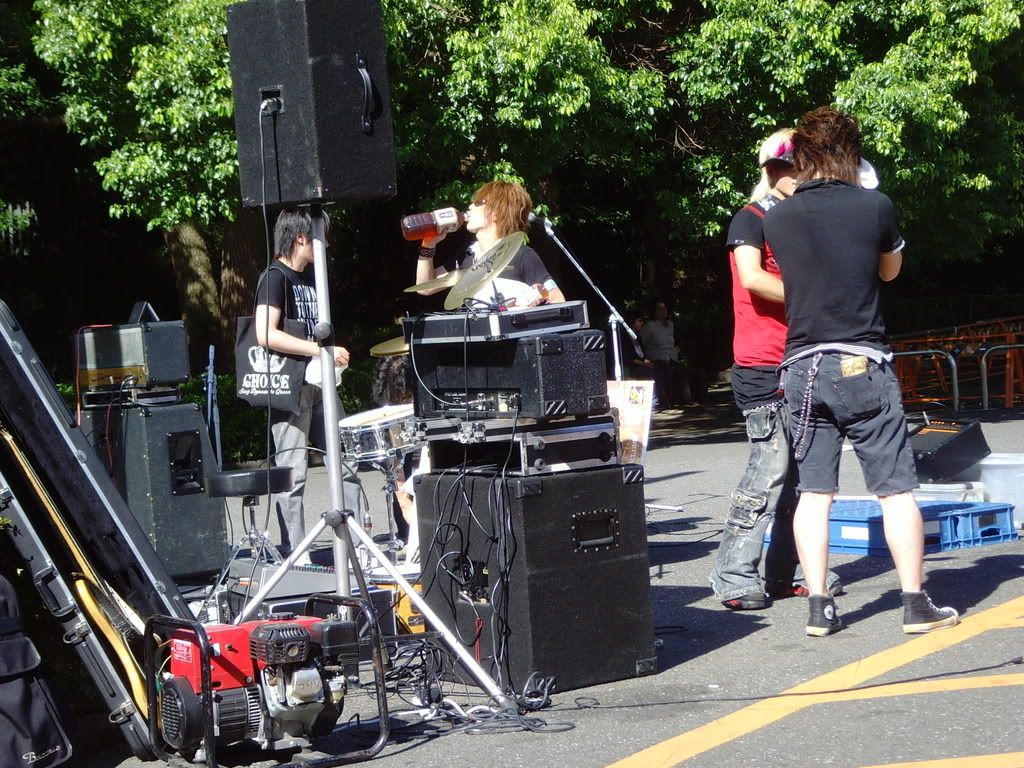
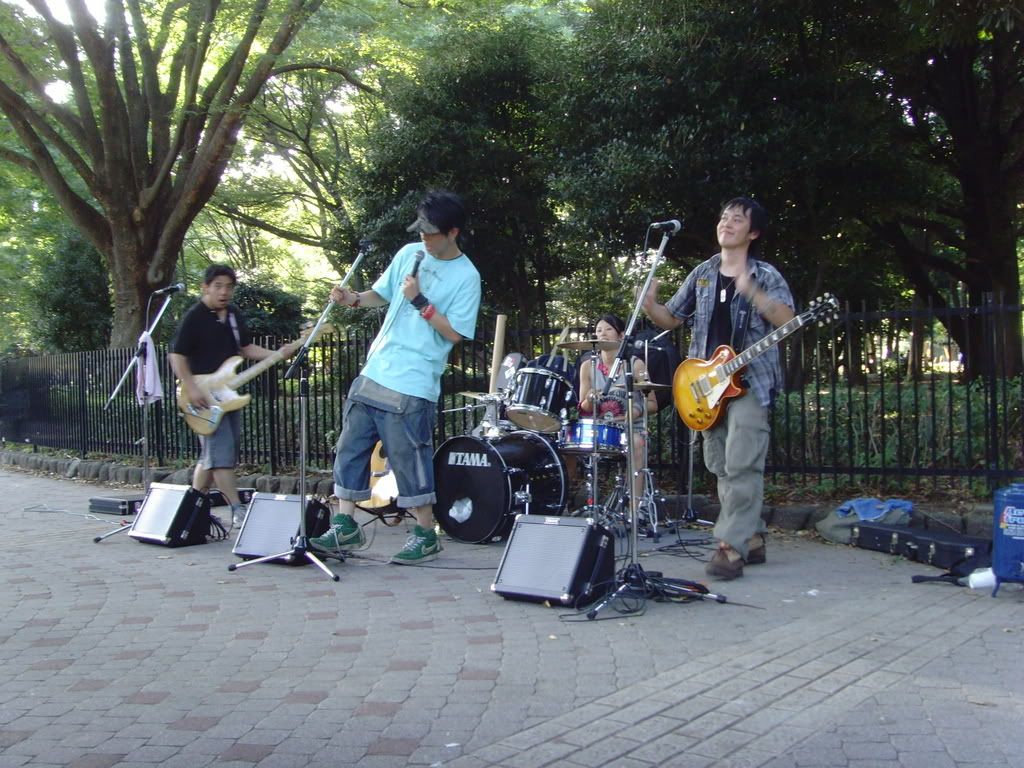
So, here's a little wrap-up for those who wanna know what happened with all that Yoyogi Park band.

I went to Yoyogi with a friend of mine, since we both needed to take some pictures (me for a photo class, him for a communications class). This time, I actually went into the park instead of hanging around the street next to it. The interior didn't look too promising the last time I went, but that was a Monday. This, my friends, was a Sunday.

On our way to the park, there were lots of people performing: three man bands, a single person on the piano, a break-dancing group. They were all too close to each other the music blended from one to the next as you walked down the street.

When we got alongside the park, we had to walk down the sidewalk to get to the entrance; the same sidewalk where I had met Saturday Night Bremen before. This day, there were far more people on the sidewalk--lots of people selling used stuff and bands tossed in between. There were a lot more things to see than on a Monday. Well anyhow, as we walked down this rather long sidewalk, who should I see but Saturday Night Bremen. We kinda passed slowly along and I kinda waved and Chizuru-san kinda freaked out at the coincidence. Nice people.

We talked for a bit, I introduced my friend, the subject of their upcoming live came up (of course) and I decided on the spot that I would go. I wanted to go before this chance meeting, but I didn't want to if I didn't get anyone to go with me. So I admit it--I used the situation to try to coerce my buddy into coming along with me -.- Well, it worked, and it was off to the live we go ^^ But first, the park.
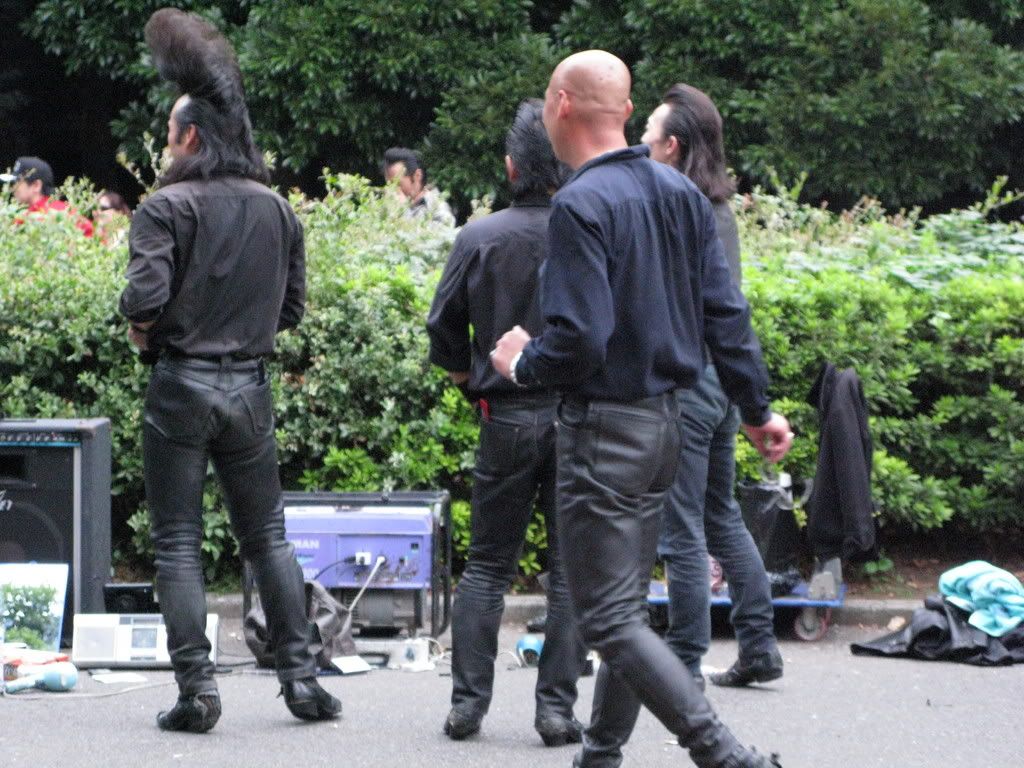
Right at the entrance to the park, there were the rock-a-billies. Middle-aged men with big hair, sunglasses, leather pants, tatoos, no shame, and some...incredible...dance moves.

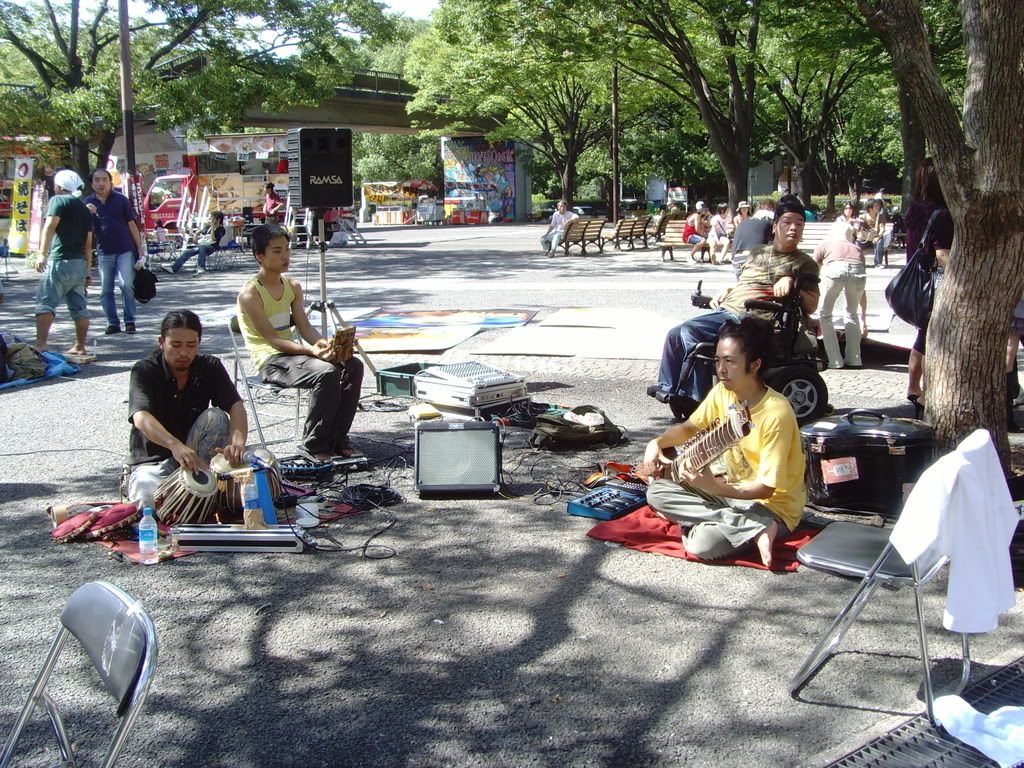
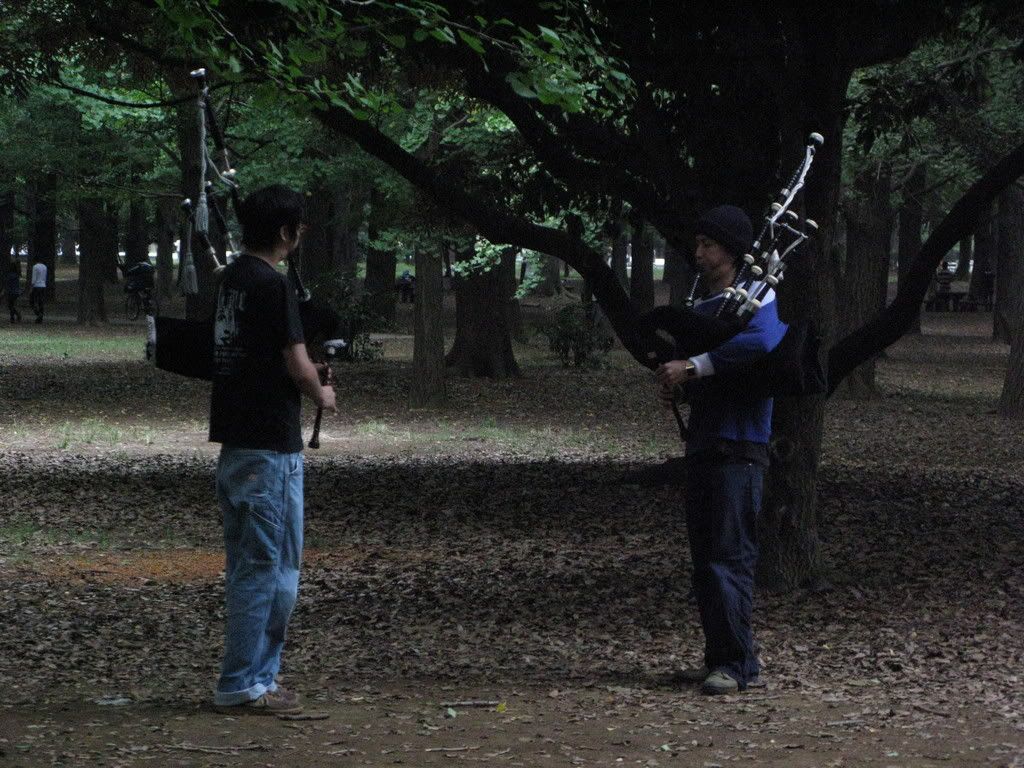
If outside the park was for rock bands and hip hop, then the inside of the park was for indigenous musics. Not necessarily indigenous to Japan. Indigenous to somewhere. They had people on bagpipes. I'll leave it at that.


After that came Wednesday, the night of the live (yes, it was that close). Me and my friend headed out to Shibuya and promptly could not find the place for the life of us. Fortunately, Justin's got a good sense of direction so we finally sniffed the place out and got in at the last song of the first band. The live house was...small. Much smaller than I had expected somehow. Full of cigarette smoke and whatever blasting song was playing next, with a little space given over for people. The music was so loud that it really seemed like there was no room for anything else physically or mentally. It was loud enough that there were a couple of times that I got dizzy from it.

Saturday Night Bremen was the star of the evening--they played last. Before them played some group whose name I can't remember because we barely made it for their last song. The other group, Lucy Juicy, did mostly a pop-ish, happy sort of rock with a cutesy girl as their lead. What was interesting about their music was the variety. Just as me and Justin were saying talking about how it would be great if they had a sort of metal-ish, not so bouncy song, here comes the minor key. It was interesting, this band. The instruments played really well together. The singer, I think, could've added more to the music--in short, she needed practice. She does, however, pull off a great performance and does a good job as a front man.

Saturday Night Bremen really showed off at the end. The difference in experience was really obvious as soon as they started playing. Couldn't tell you what it was. Can tell you that it was good. Then again, everyone in that room had come to see them, not the starter bands.

Anyways, the live ended and me and Justin headed back home. We didn't get to talk much with the band members--expected, I suppose, consider that I'd only met them three times. We chatted with the lead singer and the electric guitarist outside for a little bit as they took a break from loading their van.

I probably won't run into them again, as I don't really have any further plans to go to Yoyogi. We'll see what happens. If nothing else, maybe I'll get to see them whenever it is that I finally return to Japan after this semester.

Saturday, October 13, 2007

The Architecture Student Incident

So...
My original idea for this project had been centered around Koshigaya, which is why I put up the Noh interviews and whatnot. Then, we got the option in class to work with an architecture student (if they were willing). The catch was that you could only do certain parts of Tokyo. I really wanted to work in a collaborative project, so I jumped right on that and changed my theme to Japanese Indie rock bands. Hence, Yoyogi Park.

But, after the weeks of fuddering and meeting this teacher and that student, only one architecture student ended up pairing up with someone and that someone wasn't me. After a couple of more weeks of fuddering, it suddenly dawned on me that I didn't have to struggle with going to Yoyogi all the time (waaaaaaay out of the way) and spend tons of money going to lives and buttering up band members. Instead, I could just go back to my original (and more interesting to me) idea: Koshigaya.

Of course, that means that I'm somewhat behind in the work and need to get caught up with all that. We'll see how this goes...

Sunday, September 23, 2007

Yoyogi Park Take One

Last Monday, on I had a school holiday, so I took the chance to head over to Yoyogi Park in Harajuku. It was supposed to be my introduction into the world of indie music, namely indie rock, here in Japan. Well, I guess it was something of an introduction, since I got my foot in the door, but it was little more than that.

I only saw two bands there; apparently Sundays are the days to go, not Monday. I hear that they used to close the street next to Yoyogi Park and indie bands down line up all along the road and play. They don't close the street anymore--a sign of some change in the underground music world??--but bands still show up to play. On Sundays.

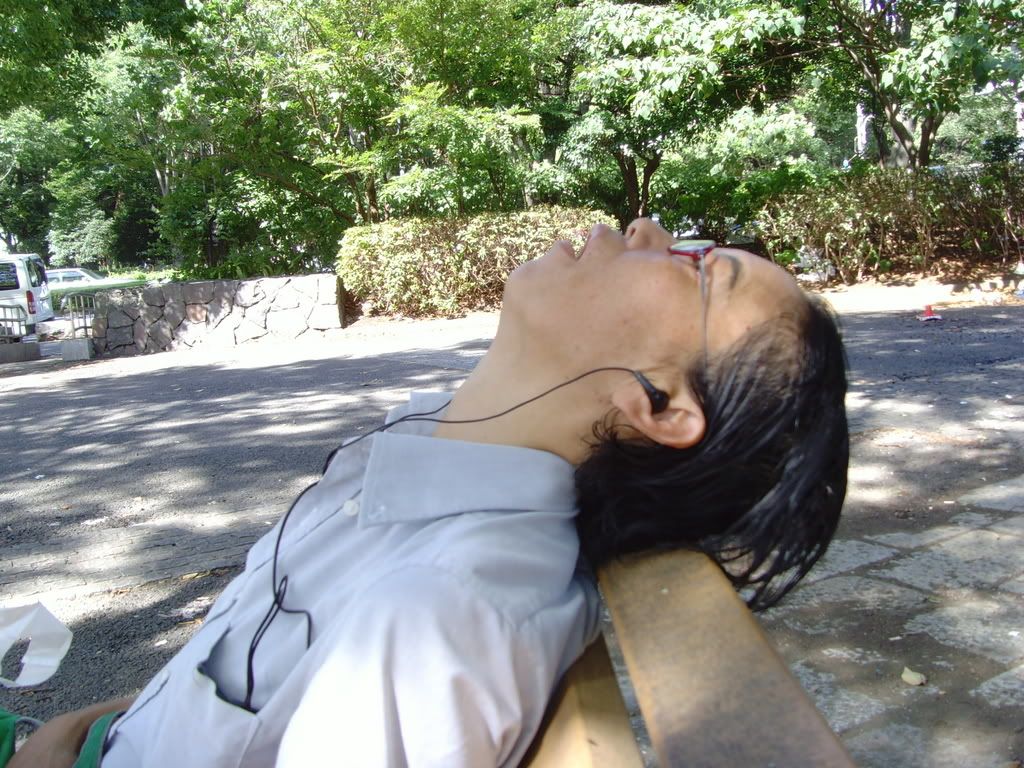
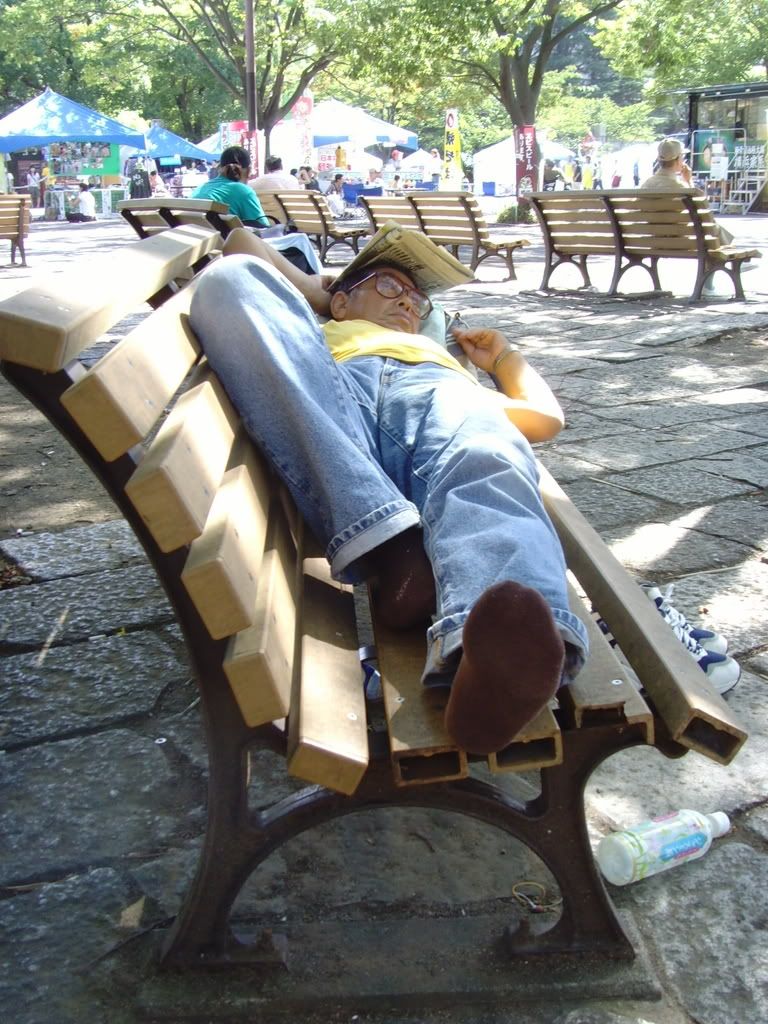
Well, when I got there, there were only two rock bands and neither was playing, so I took a looksee across the street where something was going on. It turned out to be a "Peace Festival" and there were hippies!! A little group of three were playing some music on some instruments I've never seen before. The people there really were at "peace" too. So at peace that some of them (if they weren't one of the girls lined up next to the street for god-knows-what) were asleep, blissfully unaware of a certain devious picture-taker sitting right next to them, using a yakisoba lunch as her cover.

Well, after lunch and a few pictures, I headed back to the park to see what I could see, or rather hear what I could hear, and lo and behold, one of the bands was playing-- Success!! I watched them play and at the end of it, I went up and bought their single and their mini-album. Since I was the only person buying anything, they of course took notice and told me that they'd start playing again in just a little bit. I was a bit shy, so I hurried off--a failure as an interviewer!--but came back and watched them when they started playing again. It was a good move, since after that, the band members and their manager (I think she was?) started talking to me during their breaks.

So the band is called Saturday Night Bremen (Samstag Nacht Bremen! cried the German girl who stopped to watch), and consists of a drummer, bass guitarist, electric guitarist, and acoustic guitarist/lead singer. Their music was not, perhaps, spectacular but their performance wasn't half bad. Every single one of them was very into their music. They managed to get a few people to stop and listen, but just a few. They have a live show coming up in October. I'll try to hit that and see if I can't cultivate a better relationship with the band members--the language barrier was a bit awkward. At the very least, I'll get a looksee at other bands and my first Japanese live house experience. Saturday Night Bremen might or might not be prime material for my final project, but they all seemed like good people, even if they are (as their manager swore) a little crazy. And anyways like I said, the expedition was just to get my foot in the door.

Monday, September 10, 2007

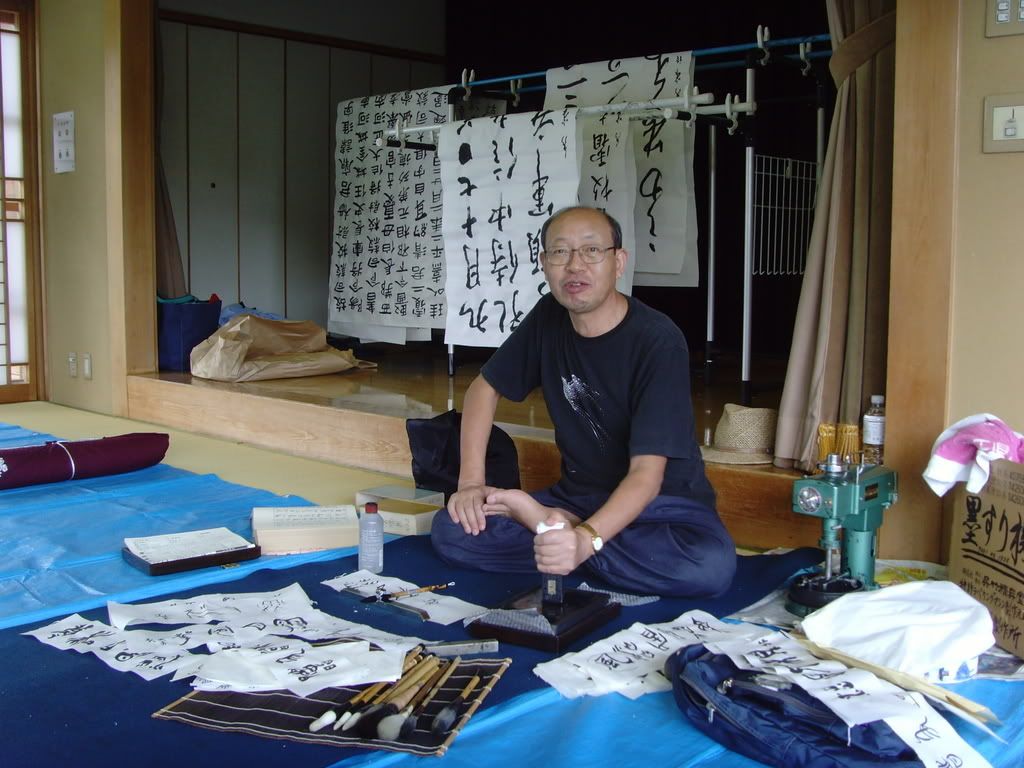
Calligraphy Interview


Noh Theater Interview


Here's a (rather rough) translation of the interview with the Noh Theater manager, Mr. Matsumoto. He said some stuff in English, which I put in quotation marks. Just to make things easier to type, I am B (for Becky) and he is M (for Matsumoto):


M: If it's about the Noh Theater, then this is good--

B: First, could you please introduce yourself?

M: Ah, a self-introduction. I am Matsumoto, the manager at this Noh Theater. This Noh Theater was, from now, 17 years..."17 years old." 17 years ago this building was built. In Japan, there are 63 of these buildings. "Places." There are 63 of them, and this one is the only one in the Saitama prefecture. There are three reasons why this theater was built: Japanese culture--to spread it, to raise the quality of culture among the citizens of Koshigaya, and to raise the level of communication among acquaintances. If was for these three reasons that this building was created. Do you understand?

B: Just a little.

M: Just a little? Well, Noh Theater is--there are three very old, traditional arts in Japan: Noh--this Noh. It's written here, see? "Noh is oldest of the classical dance dramas in Japan" is written. Well, one of the oldest cultural arts is Noh. And, do you know of Kabuki?

B: Yes, I know of it.

M: And then there is the puppet theater. That is when they use dolls. "Doll." Those are the three famous Japanese cultural arts. Three of them. "Three"--how would you say--"oldest classcial drama in Japan." Three of them, and one of them is Noh. It was to raise that bit of culture that this theater was made. Well, then let's take a look at the peculiarities of this theater.

[walking]

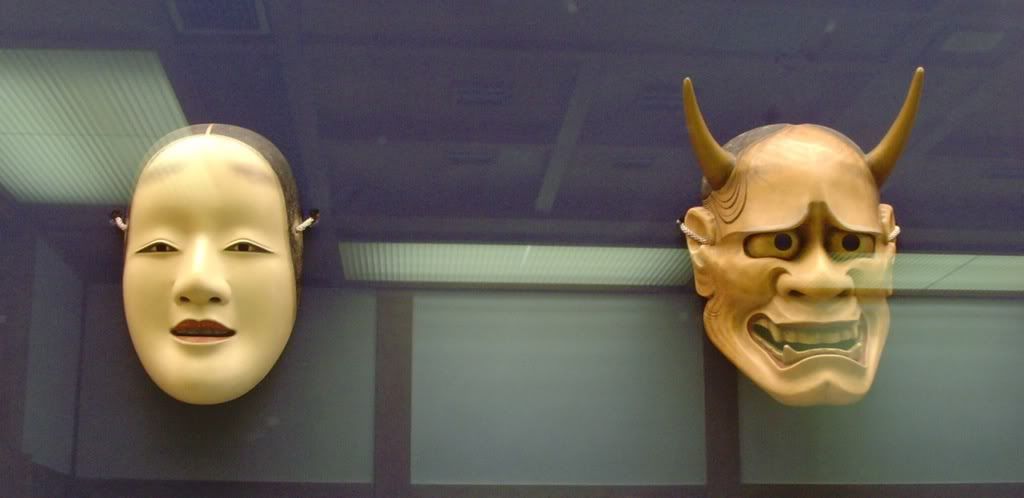
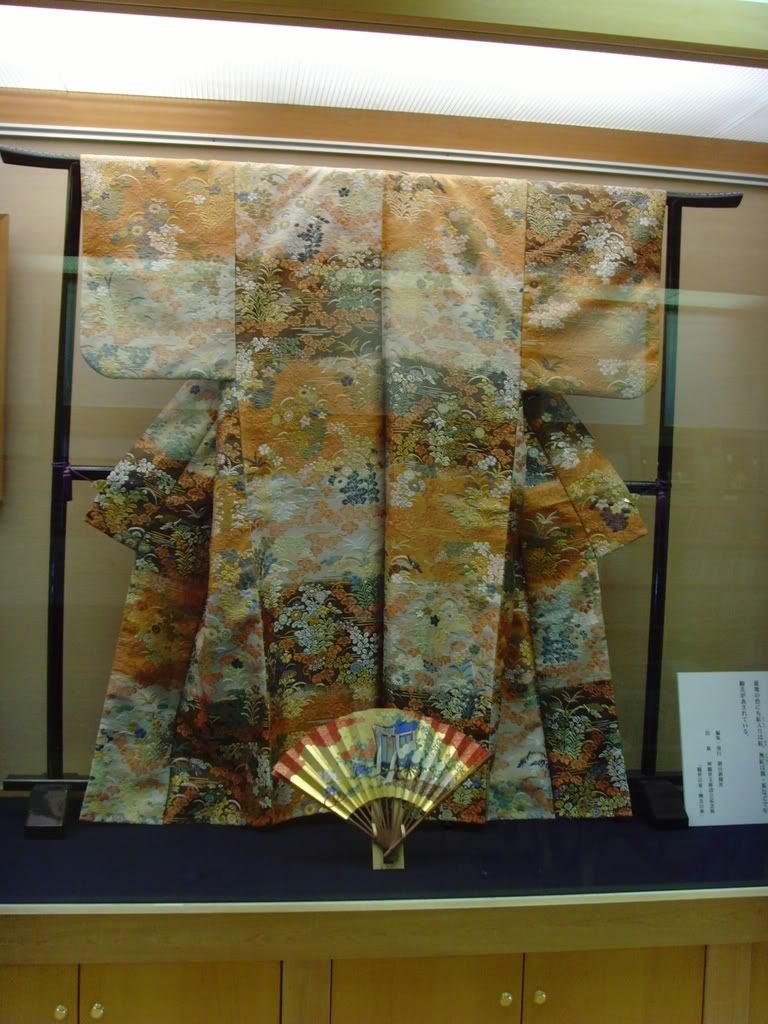
M: This is the costume the actors wear when they go on-stage, go out on the "stage." It's called shozoku. In English, I suppose it would be something like "dress." They put this on and...This is the mask. In Japanese, you write it with that character. It can be pronounced "men" but it's also pronounced "omote." An omote is a mask that is worn on the face. The masks that exemplify the rest are--total there are "240 kinds of omote," around 240 of them. And we are talking about the ones that exemplify all of those. And this is, one of the masks that exemplify the omote, the Hanya. This one is the Young Woman. It's the "lady." Is it "lady?" Well, anyways, "woman." A woman. This [the Hanya] is also one. "Too." This is also a Young Woman, but when she is mad with anger.

B: Ah.

M: When she is mad with anger, her face becomes like this.

B: Is that so?

M: Do you understand?

B: Yes.

M: When she is mad with anger, it's this. Well, these are the masks that exemplify the omote. These are the masks that exemplify the 240+ masks that might appear. So, wearing this sort of thing on their face and wearing this sort of costume, the actors dance on the stage. Dancing is "dance." In English, I suppose it would be "dance." And they sing. How can I explain what singing is?

B: Singing?

M: Singing. When you send out your voice. For example--"for example"--

[Sings]

M: Sending out your voice like that. They have the dress on and do something like this.